The Infinite Jukebox: How Streaming Saved Niche Music
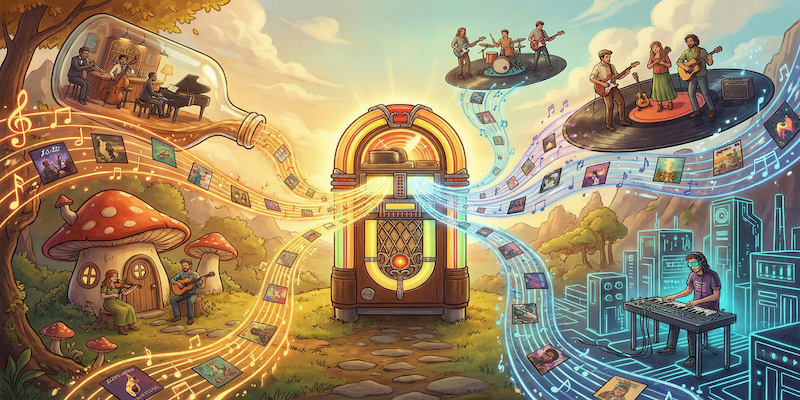
Once upon a time, music lived on shelves. In the fluorescent aisles of Tower Records or HMV, a few lucky albums got the spotlight while thousands more never made it out of the basement. Space was precious. If your band couldn’t sell enough copies to earn its square foot of retail real estate, you were quietly evicted. Shelf space was currency—and scarcity ruled everything.
That world, charming as it was, was also brutally narrow. We lived in a world of “hits” not because they were inherently better, but because there simply wasn’t room for anything else. Every record store was a mirror of the same mainstream universe: Britney Spears, U2, and whatever new sound the major labels had decided was “in” that year.
From Scarcity to Abundance
Then, something extraordinary happened. The shelf disappeared.
Streaming platforms—Spotify, Apple Music, YouTube Music, SoundCloud—rewrote the physics of the industry. They introduced a universe without physical limits. Hosting one obscure jazz track from Norway costs them the same as hosting the latest Beyoncé single: virtually nothing. The economic gravity shifted overnight—from scarcity to abundance, from gatekeeping to access.
In this new ecosystem, a song doesn’t have to fight for visibility on a rack; it just has to exist. And if even one listener, somewhere in the world, adds it to a playlist, it begins to live. Music is no longer bound by geography, label politics, or warehouse logistics. The algorithm became the new radio DJ.
The Long Tail Lives
This is the essence of the Long Tail—the idea that countless niche products, each with modest demand, together form a market as big (or bigger) than the mainstream “hits.”
In streaming, that theory isn’t just alive—it’s the engine. Millions of tracks outside the Billboard Top 100 now account for the majority of listening time. Listeners dive deep into rabbit holes of hyper-specific genres: Brazilian shoegaze, medieval folk electronica, lo-fi beats sampled from Soviet cartoons. The digital landscape rewards curiosity over conformity.
The music industry, once a vertical skyscraper of hits, has flattened into a vast horizontal sprawl. Every track, no matter how small, stands on the same infinite plane. The algorithms don’t care if you’re Taylor Swift or a teenager in Jakarta with a cracked copy of FL Studio—they’ll still recommend your song if the data fits.
Five Thousand Fans Are Enough
For musicians, this new geometry is liberating. In the old model, survival meant selling millions. Now, 5,000 true fans can sustain an artist’s entire livelihood. Those listeners might be scattered across continents—from Tokyo to Toronto to a single devoted listener in Tunis—but together they form a digital micro-ecosystem strong enough to fund tours, merch, and creative independence.
The Long Tail aggregates what the analog world fragmented. It gives artists permission to stay small, authentic, and weird—and still be heard.
The Algorithms as Archaeologists
One of the strangest outcomes of streaming culture is how algorithms have become unexpected archaeologists of forgotten sound. They resurrect lost voices: a 1977 Japanese city-pop single goes viral on TikTok; an obscure Ethiopian jazz record finds a second life through a Netflix soundtrack; forgotten indie acts wake up to see their twenty-year-old demos trending in Brazil.
For all the cynicism about “the algorithm,” it sometimes performs an act of cultural preservation. It digs up what humans buried.
What It Means for You
For listeners, the payoff is endless discovery. Your playlists can be as personal as your DNA. You can build an identity not around what’s popular, but around what feels like you. You can start your morning with Icelandic post-rock and end your night with Mongolian throat singing. The Infinite Jukebox has no closing time.
For artists, it means you no longer need to beg for a label’s validation. The only real gatekeeper is attention—and even that has been fractured into millions of micro-audiences. In a sense, every listener is now a curator, every playlist a new cultural magazine.
The Spirit of the Long Tail
I see the same principle in my own projects. Just as my site Kakuro.com thrives by serving a niche community of puzzle enthusiasts, streaming platforms survive by embracing infinite diversity. The “Head” of the curve—Taylor Swift, Drake, Bad Bunny—will always be enormous. But the real richness of culture lives in the “Tail”: in the experimental, the regional, the intimate, the overlooked.
The future of music isn’t about chasing hits—it’s about sustaining worlds. Every micro-genre, every rediscovered demo, every one-listener-a-month song adds another pixel to the grand mosaic of global sound.
Somewhere tonight, an artist you’ve never heard of is uploading a song that will mean everything to someone you’ll never meet. That, in itself, is the quiet miracle of the streaming age: the jukebox is infinite, and so is the human need to listen.
← Back to Home