The Cinema of You: Why Netflix Loves Niche Movies
Picture the average theater in 2005. Ten screens, eight of them showing superhero sequels, one a romantic comedy, and maybe—if you were lucky—a “serious” Oscar contender squeezed into the smallest room. If you wanted a documentary about competitive crossword puzzles or a low-budget Icelandic coming-of-age film, your odds were slim. Not because no one cared—but because there wasn’t enough room. The economics of cinema required each seat to be filled, every showtime to justify its real estate. Anything niche was exiled before it could even arrive.
Then came the algorithm.
The Algorithm Is the New Box Office
Netflix didn’t just digitize movie rentals—it demolished the physics of scarcity. Where a multiplex could host ten stories, Netflix could host ten thousand. But more importantly, it could *find the right ten thousand people* for each story. It no longer mattered whether a film could fill a theater in Chicago—only that it could find a heartbeat somewhere in the world willing to watch.
The old Hollywood model was a funnel: billions spent to chase one global hit. The new streaming model is a constellation—millions of smaller lights, each glowing for its own tribe. The documentary about sushi chefs. The 1980s sci-fi B-movie with cardboard spaceships. The Portuguese coming-of-age short that quietly changes someone’s life at 2 a.m. on a Tuesday. Netflix realized what the movie industry forgot: not everyone likes the same thing, but *everyone* likes something deeply.
The Power of Recommendation
The Long Tail doesn’t thrive on quantity—it thrives on *connection*. Having a million films is meaningless if no one can find them. That’s where the recommendation engine becomes the invisible curator. It learns your midnight obsessions, your guilty pleasures, your nostalgia triggers, and whispers, “If you liked this, you’ll love that.” It’s not a blockbuster machine—it’s a mirror.
In a sense, Netflix built the world’s most personal cinema. There’s no box office pressure, no critics gatekeeping the schedule. The algorithm quietly replaces the old poster-lined lobby, suggesting not what’s popular—but what’s *yours*.
It’s the same philosophy that drives my work with Gomoku.com. In the world of board games, chess is the blockbuster—polished, timeless, and universally known. Gomoku, on the other hand, is the cult classic: brilliant, minimalist, and loved by a small but passionate audience. By creating a dedicated platform, I’m doing what Netflix does for film—I’m giving that niche its own stage. Its own algorithm. Its own home.
From Megaphone to Mosaic
The Long Tail transforms entertainment from a megaphone shouting one message to everyone into a mosaic of whispers—millions of individual conversations between creator and viewer. The blockbuster still matters, but it no longer defines the culture. The smaller voices now sing in harmony, forming a chorus that’s infinitely more interesting than a single tune.
Once upon a time, your taste was constrained by geography and distribution. You watched what your local theater decided to show. Now, you watch what *you* decide to love. A Filipino horror film can trend in Mexico. A Polish black-and-white short can make waves in Brazil. A forgotten 1970s Hong Kong kung fu flick can suddenly dominate Reddit threads and Letterboxd lists. The tail never sleeps—it just keeps extending.
The Cinema of You
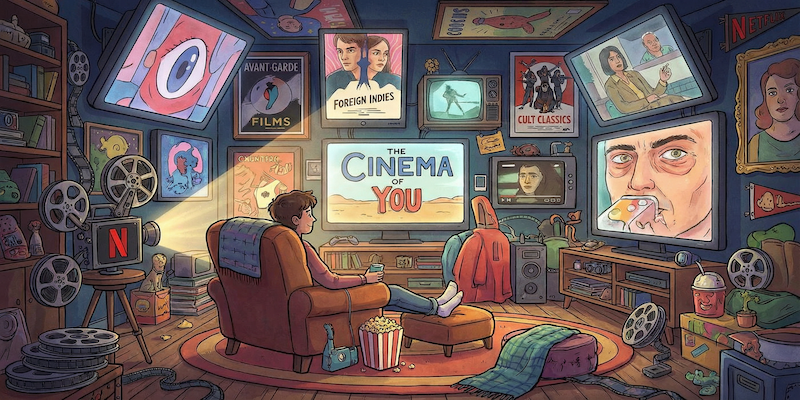
Streaming didn’t kill cinema—it personalized it. It replaced the ticket counter with a recommendation feed and the projectionist with an algorithm that knows your moods better than you do. The result isn’t one collective blockbuster weekend, but billions of quiet premieres happening simultaneously in living rooms around the world.
Somewhere, right now, a filmmaker who thought no one would care is reaching their perfect audience—a dozen viewers, maybe a thousand—who feel seen for the first time. That’s the quiet revolution of the Long Tail. The screen is smaller, but the universe behind it is infinite.
The cinema of the future doesn’t belong to “everyone.” It belongs to *you*.
← Back to Home