The Story Behind LongTail.com
My fascination with the internet started at age 12, when I taught myself how to build websites from scratch. What began as curiosity quickly became a passion—I devoured everything I could learn about the web and earned my first dollars through online advertising. Those early experiments set the foundation for my career.
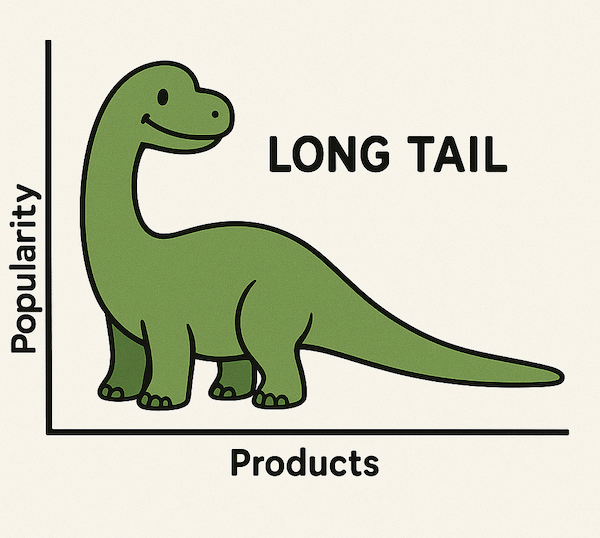
In college, I discovered a book that would reshape my entire approach to business: The Long Tail by Chris Anderson. The concept was elegantly simple yet profoundly powerful—the internet enables niche products and interests to find their audiences at scale. Better still, these niches are often far less competitive than mainstream markets, creating fertile ground for creative entrepreneurs willing to go deep rather than broad.
Since then, I've built my career around this principle, applying the long tail strategy to domain investing, keyword marketing, and niche website development. The approach has transformed my life. And in a serendipitous twist, I eventually acquired this very domain—LongTail.com—from Chris Anderson himself.
Let me show you how the long tail works in practice through three real-world examples from my portfolio:
Gomoku: The Long Tail of Strategy Board Games
Consider Gomoku.com. In the world of strategy games, Chess dominates the "head"—platforms like Chess.com boast over 100 million registered users. Gomoku, a beautifully simple yet strategically deep game popular across Asia, occupies the long tail with roughly 10 million dedicated players worldwide. That's still a massive audience. By building the definitive online destination for Gomoku enthusiasts, I can serve this community better than any generalist platform ever could.
Mont-Saint-Michel: The Long Tail of Travel Destinations
MontSaintMichel.com demonstrates the same principle in travel. France attracts over 100 million visitors annually—the undisputed "head" of global tourism. But rather than compete for impossibly broad "France travel" searches, I focused on Mont-Saint-Michel, the magical tidal island that draws 3 million visitors each year. By creating the most comprehensive online guide to this UNESCO World Heritage site, I've carved out a prominent position in a space where giants rarely venture.
Kakuro: The Long Tail of Number Puzzles
Perhaps my favorite example is Kakuro.com. Sudoku stands as the undisputed king of number puzzles—a global phenomenon with hundreds of millions of players. Kakuro, often called Sudoku's sister puzzle, lives comfortably in the long tail. What makes Kakuro special is how it blends the logic of crossword puzzles with Sudoku's number-placement mechanics, resulting in a uniquely challenging experience that many find more rewarding than Sudoku itself.
While Kakuro hasn't achieved mainstream recognition, consider this: even one percent of Sudoku's global player base represents millions of dedicated puzzle enthusiasts. By serving this passionate niche community exceptionally well, a "small" market becomes anything but small. That's the magic of the long tail amplified by the reach of the internet.
The lesson is clear: find your niche, commit to serving it better than anyone else, and extraordinary things become possible.
Kakuro.com – Free online Kakuro puzzles
Gomoku.com – Play Gomoku online
MontSaintMichel.com – Mont-Saint-Michel travel guide
Seine.com – Seine River in Paris
HCMC.com – Ho Chi Minh City travel guide
TrackAndTrace.com – Universal package tracking
dotDB.com – Domain research database